Showing posts with label spokesperson. Show all posts

Sunday, August 7, 2016

Random Post Time


The 6-month (!!!) span between this post and my last entry correlates with a lot of activity on the home front and at work. I've also struggled finding topics to cover. I've always tried to center on advertising techniques that I find interesting or tactics that I want to learn more about. The point of this post is to bust the atrophy off my writing muscles. I'll do that by touching on a few topics that I've considered covering on this blog. Maybe I'll expound on these topics in their own posts. This post, however, scores off the Randometer charts. Sorta like this Bitmoji.


(Some friends at work introduced me to Bitmojis, which may or may not have contributed to that 6-month span.)

Sports Cards and Marketing

Growing up, baseball card collecting was a huge hobby of mine. I spent hours reading the stats on the back of cards and looking over every last detail of the photos on the front of the cards. It's hard to imagine getting so much enjoyment out of pieces of cardboard. The internet was not a thing yet so all that I learned about the hobby came from interacting with my friends. I was recently served the following ad while killing time on YouTube.


Sports cards have changed and so have the marketing efforts of card companies.

Instagram Frustration

I want to keep my Instagram profile public so I can continue embedding posts from my account. Unfortunately, some very questionable accounts have declared open season on my profile. Anyone can follow my public profile without requesting permission and boy do I attract some weirdos. I'm certain these are not actual people - they're obviously phony profiles. Each one has zero posts and zero followers but are following several hundred accounts.

I'm blocking most of these followers but if you know of a way I can fend off these weirdos while keeping my profile public, please leave me a tip in the comments!

NIKE Golf

So NIKE just announced that they will no longer manufacture golf clubs, balls or bags. They will continue to make golf shoes and apparel.

I think a lot of people share my stance on NIKE's equipment. I don't think the lack of equipment will hinder the success of their shoes and apparel. I've been a fan of both and have never owned a NIKE club.

Yep. Played on the Farm Links greens today!

A photo posted by Nick Baggett (@nick_baggett) on


Jim Varney

I was flipping TV channels the other day and came across the description for the 1993 Beverly Hillbillies movie, in which Jim Varney played the lead role. I never realized that he starred in any movies other than his "Earnest" films. Where a lot of people remember him for his movie roles, I remember Varney more for his 1980s television commercials. I've written before about the risks of celebrity endorsements and the safety of character endorsements. Reading up on Varney, I learned that he was a central part in a unique marketing strategy that enabled him to gain acting work across the country because he was not (yet) a nationally-recognized figure. This interview touches on that concept:


This approach allowed the commercial directors to use the same story frame for multiple ads and products.

For example, here's a local ad for Doubles Pizza.


And here's the same type of ad for Mello Yello.


Wonder why Vern was always on his roof?? And will we see a return to this kind of simple character endorsements?

OK, told you this post was going to be chopped full of randomness. I hope to return to consistent posting now!

Thursday, March 12, 2015

Thanks, Captain Obvious


I've mentioned before that when it comes to advertisements directed at me, I can't see the forest for the trees. Most of the time, I'm unable to follow through with an advertiser's desired response because I'd rather focus on trying to answer questions like, “Hey, how’d they do that?”

This happened most recently while I was watching a few episodes of a television series streamed on Hulu Plus. This particular show lasted about 45 minutes and allowed for three or four 1-minute ad breaks per episode. I was very impressed when I noticed the following ads for Hotels.com spread out in succession during the breaks:


FIRST IMPRESSIONS
  • Obviously, how'd they do that?! These three spots played in the proper order, if you will.
  • I like that the Captain acknowledges the low probability of viewers actually paying attention to the spots.
  • Searching for the best deals on hotel rooms is something I don't do often. With that in mind, I’m amazed that there's enough competition in the world of hotel booking to warrant this level of advertising.
OTHER TAKEAWAYS
  • According to this article from Adweek, the Captain Obvious campaign is fairly new. The videos above were posted to Hotels.com's YouTube channel a few days before this post.
  • I’m a little leery of Captain Obvious's Twitter account. It seems odd that a highly desirable Twitter handle the likes of @CapatainObvious would be available for such a new character and account. Perhaps it was purchased? Or maybe the ad agency that created the character smartly claimed the name before Hotels.com came calling?
  • Also, for an account that was created in November of 2013 and only follows 10 accounts, the Captain's 94,000+ followers seems awfully high. Perhaps they were purchased?
  • Then again, maybe such a skewed following is perfectly explained by Hotel.com’s affiliation with over 240,000 hotels from around the world? Like I said, I’m certainly not up-to-speed on the hotel booking industry.
So thanks, Captain Obvious, for being a new, fictional spokesman on the scene - for all the reasons I mentioned in an earlier post. Where will we find you next??

{Top Photo: Unsplash}

Thursday, December 18, 2014

Santa in Advertising


Writing my previous post about the gambles associated with spokespersons made me think about Santa Claus and his appearances in advertisements. He’s a staple of Coca-Cola commercials each year around Christmas. Other than that though, that’s really the only product I see St. Nick pushing.

A little research revealed that folks at Coke made Santa a company man a long, long time ago.


You just can’t beat the iconic Coca-Cola Santa and it seems that other advertisers haven’t even tried! However, I came across one website that claims another carbonated beverage, White Rock, featured Santa in their ads well before he was seen in Coca-Cola marketing pieces.

I also learned that Santa’s likeness has been utilized in print advertisements for products that would be considered taboo by today’s standards. Yes, it’s no secret that Santa smokes but I never knew that he preferred cigarettes that were easy on his throat until I came across this collection from the Stanford School of Medicine.

Stanford School of Medicine
Santa probably no longer promotes cigarettes for the same reason smiling cartoon camels are no longer permitted to do so. It should be noted that these images of a smoking Santa debuted around the same time as Coke’s Sundblom Santa. Since that time, Santa has remained a loyal Coca-Cola spokesman...except when he’s on vacation, of course.

I really want to learn how or why The Coca-Cola Company gained such a tight hold on Santa’s image over the years. If you know of of these details, please leave them in the comment section or feel free to contact me on Twitter. Thanks for your help!

Thursday, December 4, 2014

Max Headroom: First Spokesperson I Noticed


The practice of using a spokesperson to promote a service or good isn't new. A spokesperson allows consumers to associate a trusted face with a product. I would think that being a spokesperson for a nationally-sold product is a good (and highly compensated) gig. The time it takes to reach "spokesperson" status varies but make one mistake and that opportunity is gone in a flash.

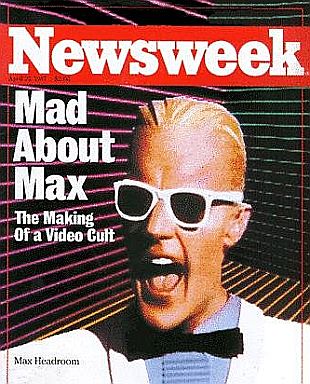
When I think about my personal awareness of spokespersons, the earliest example that comes to mind is Max Headroom. Maybe it was because he wasn't exactly human. Maybe it was because he was purposely targeting kids like me. No matter the reason, I was amazed by this futuristic promoter of New Coke. The fact that Max was everywhere - TV, magazine covers, games - made him even cooler. Access to information back then wasn't quite like it was today so I gave credit to The Coca-Cola Company for developing such a unique character. It was only until recent years that I learned that Max had a lot going for himself before Coke came calling.

Newsweek - April 1987
BRIEF HISTORY OF MAX HEADROOM
  • Max’s first appearance came in a 1985 British TV film titled, Max Headroom: Twenty Minutes into The Future. The character of Max was a hit and he was made part of a British music video show (remember those?) that same year. 
  • America caught wind of Max’s popularity and he was given his own show on Cinemax in 1986. The series (titled Max Headroom) was based on the original film. 
  • In 1986 and through 1987, Max was tapped to be the face of New Coke as The Coca-Cola Company scrambled to develop a separate campaign that promoted Coca-Cola Classic, which had to be created in response to the negative reception of New Coke. The Coca Cola Company probably couldn't simply scratch New Coke entirely and Max was a great fit. If there’s anything I remember about New Coke, it’s definitely Max's "C-c-c-catch the Wave" slogan.
  • Max's popularity peaked in 1987. His likeness was featured on t-shirts, posters, toys - you name it. Even a Max Headroom mask made an appearance in one of the more significant incidences in broadcast television history. A small group of people that had the intelligence and equipment needed to interrupt the signals of Chicago-based WGN did so on November 22, 1987. This recent article from Wired recapped the incident and you can watch the video for yourself on YouTube. It's one of the eeriest videos I've seen on YouTube. The hijack itself was scary as it exposed the vulnerability of broadcast signals at the time. 
I came across most of these facts from Wikipedia. Please check out Max's wiki page and be sure to read over the wealth of information found at Pop History Dig.

LIFE AFTER NEW COKE

New Coke may have been a flop but it opened more doors for Max. He was the subject of another TV show in 1987, this time on a major network - ABC. And get this: Max also was the host of a talk show on Cinemax in which he conducted interviews with celebrities of the day. Unfortunately, the shows weren't popular and big portion of Max's visibility took a hit as The Coca-Cola Company worked to turn New Coke into a fading memory.

My search to find elements of Max Headroom's "work" after 1987 came up empty. The only noticeable example I came across a series of creative ads that aired in 2007 informed viewers in Britain about the upcoming switch to a digital broadcast signal.


MAX'S IMPACT ON SPOKESPERSONS 

Arguments can be made for using characters or real people as your spokesperson. Real people, like Bill Cosby, have a history of letting you down. Sure, the actress may run afoul but we'll never see news reports about the legal troubles of Flo from Progressive.

I realize that you lose heat-of-the-moment recognition when taking a conservative approach to selecting a spokesperson but Max Headroom showed that it's possible to make a lasting impact without the risk of human flaws creating drama for your company.