Showing posts with label Coca Cola. Show all posts

Thursday, January 15, 2015

A Missed Target in the Soda Wars


I'm a bit of a challenge for my fellow advertisers when it comes to casting marketing messages my way by traditional methods. I'm a proud cord-cutter and don't do appointment television so it's almost impossible to catch my attention with TV ads. In the car, I switch stations so fast during commercial breaks that it's almost like an instinct. Forget newspaper and magazine ads too.

My recent post about the relationship between Santa Claus and the Coca-Cola Company made me consider the ways such a huge company (and Coke's competitors) could reach people like me. So I made a quick list of the main ways advertisements reach me in my personal life:
  • Web ads based on browser activity.
  • Preroll advertisements on YouTube and Hulu Plus.
  • Ad breaks on my free Pandora account.
  • Sponsored posts on Twitter and Facebook.
  • Email subscriptions. 
I'm sure I'm missing a few but the list isn't very long - and these are all channels that are clearly not traditional methods. 

So back to Coke. They cover the globe with advertising and, to keep up, Pepsi does too. Their behemoth brands are instantly recognizable and the Soda Wars require each company to keep pushing. But as I thought more about how these companies reach people like me, I realized that it's been a while since I've seen any type of ad from Coke or Pepsi. I really racked my brain and came up empty. So, starting with a clean slate, I kept track of any exposure I had to these brands for 2 weeks. Here are the results:

First, Coke:
  • I went to a movie in a theater that serves Coke products. After an seemingly endless run of ads, trivia and etiquette reminders, a Coke ad appeared just before the movie began. You know the one - ice cubes fall from the top of the frame, clinking along until they fill up the entire screen. Audio of a beverage being opened follows this image, which is then covered by a poured soda. 
  • I happen to follow Coke on Tumblr, which I forgot because their posts get lost in the mix. But, a few weeks after the movie theater ad, I scrolled past the Coke Tumblr in my feed and a bright, red image that featured the white silhouette of the Coke logo definitely caught my eye.
That's all! Two instances in two weeks! 

Pepsi didn't perform much better:
  • I spend a lot of time watching videos on YouTube and lately I've come to really appreciate the perspective given by drone videos. During my 2-week experiment, I happened to come across this video that featured drone footage of New York City's five boroughs. Here's a screen cap of something in that video that stood out: 
  • I also find myself watching a lot of viral videos on YouTube, like this one that featured some cool, slo-mo footage of a room full of mouse traps being set off by ping pong balls. Turns out that this viral hit was made possible by it's sponsor, Pepsi Max. I know...it's not Pepsi, but it's in the family.
That's all for Pepsi. It's a tie. For the most part, I was a missed target during this observation of the Soda Wars. I'm not sure what to make of this. My only conclusion is that I'm not a very "visible" target by traditional means and, because I don't search for or visit the websites of these brands, I don't appear in new media cross hairs either. 

I know I'm not the only person that is exposed to ads exclusively by way of the methods I mentioned at the beginning of this post. Time will tell if big brands make adjustments and the Soda Wars impact my life once again.  

Thursday, December 18, 2014

Santa in Advertising


Writing my previous post about the gambles associated with spokespersons made me think about Santa Claus and his appearances in advertisements. He’s a staple of Coca-Cola commercials each year around Christmas. Other than that though, that’s really the only product I see St. Nick pushing.

A little research revealed that folks at Coke made Santa a company man a long, long time ago.


You just can’t beat the iconic Coca-Cola Santa and it seems that other advertisers haven’t even tried! However, I came across one website that claims another carbonated beverage, White Rock, featured Santa in their ads well before he was seen in Coca-Cola marketing pieces.

I also learned that Santa’s likeness has been utilized in print advertisements for products that would be considered taboo by today’s standards. Yes, it’s no secret that Santa smokes but I never knew that he preferred cigarettes that were easy on his throat until I came across this collection from the Stanford School of Medicine.

Stanford School of Medicine
Santa probably no longer promotes cigarettes for the same reason smiling cartoon camels are no longer permitted to do so. It should be noted that these images of a smoking Santa debuted around the same time as Coke’s Sundblom Santa. Since that time, Santa has remained a loyal Coca-Cola spokesman...except when he’s on vacation, of course.

I really want to learn how or why The Coca-Cola Company gained such a tight hold on Santa’s image over the years. If you know of of these details, please leave them in the comment section or feel free to contact me on Twitter. Thanks for your help!

Thursday, December 4, 2014

Max Headroom: First Spokesperson I Noticed


The practice of using a spokesperson to promote a service or good isn't new. A spokesperson allows consumers to associate a trusted face with a product. I would think that being a spokesperson for a nationally-sold product is a good (and highly compensated) gig. The time it takes to reach "spokesperson" status varies but make one mistake and that opportunity is gone in a flash.

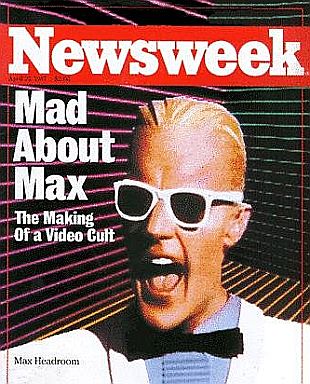
When I think about my personal awareness of spokespersons, the earliest example that comes to mind is Max Headroom. Maybe it was because he wasn't exactly human. Maybe it was because he was purposely targeting kids like me. No matter the reason, I was amazed by this futuristic promoter of New Coke. The fact that Max was everywhere - TV, magazine covers, games - made him even cooler. Access to information back then wasn't quite like it was today so I gave credit to The Coca-Cola Company for developing such a unique character. It was only until recent years that I learned that Max had a lot going for himself before Coke came calling.

Newsweek - April 1987
BRIEF HISTORY OF MAX HEADROOM
  • Max’s first appearance came in a 1985 British TV film titled, Max Headroom: Twenty Minutes into The Future. The character of Max was a hit and he was made part of a British music video show (remember those?) that same year. 
  • America caught wind of Max’s popularity and he was given his own show on Cinemax in 1986. The series (titled Max Headroom) was based on the original film. 
  • In 1986 and through 1987, Max was tapped to be the face of New Coke as The Coca-Cola Company scrambled to develop a separate campaign that promoted Coca-Cola Classic, which had to be created in response to the negative reception of New Coke. The Coca Cola Company probably couldn't simply scratch New Coke entirely and Max was a great fit. If there’s anything I remember about New Coke, it’s definitely Max's "C-c-c-catch the Wave" slogan.
  • Max's popularity peaked in 1987. His likeness was featured on t-shirts, posters, toys - you name it. Even a Max Headroom mask made an appearance in one of the more significant incidences in broadcast television history. A small group of people that had the intelligence and equipment needed to interrupt the signals of Chicago-based WGN did so on November 22, 1987. This recent article from Wired recapped the incident and you can watch the video for yourself on YouTube. It's one of the eeriest videos I've seen on YouTube. The hijack itself was scary as it exposed the vulnerability of broadcast signals at the time. 
I came across most of these facts from Wikipedia. Please check out Max's wiki page and be sure to read over the wealth of information found at Pop History Dig.

LIFE AFTER NEW COKE

New Coke may have been a flop but it opened more doors for Max. He was the subject of another TV show in 1987, this time on a major network - ABC. And get this: Max also was the host of a talk show on Cinemax in which he conducted interviews with celebrities of the day. Unfortunately, the shows weren't popular and big portion of Max's visibility took a hit as The Coca-Cola Company worked to turn New Coke into a fading memory.

My search to find elements of Max Headroom's "work" after 1987 came up empty. The only noticeable example I came across a series of creative ads that aired in 2007 informed viewers in Britain about the upcoming switch to a digital broadcast signal.


MAX'S IMPACT ON SPOKESPERSONS 

Arguments can be made for using characters or real people as your spokesperson. Real people, like Bill Cosby, have a history of letting you down. Sure, the actress may run afoul but we'll never see news reports about the legal troubles of Flo from Progressive.

I realize that you lose heat-of-the-moment recognition when taking a conservative approach to selecting a spokesperson but Max Headroom showed that it's possible to make a lasting impact without the risk of human flaws creating drama for your company.

Thursday, June 27, 2013

A Great Answer to Ad Blindness

Advertisers spend a great deal of time and resources developing campaigns – only to become victims of ad blindness. Ad blindness pertains to a consumer’s unconscious ability to look past, over and around advertisements. Many websites attempt to combat ad blindness by shaking up their page layout just as consumers are getting used to it. DVRs have all but sealed the fate of television commercials.

So, battling ad blindness requires a bit of cleverness and I recently came across a great example from the Coca-Cola Company. Take a look at how they forced people to look at their bus stop posters.


Looks like it worked to me! People were actually leaning on the posters without giving a moment’s notice to the message. The Velcro attached to their clothing (and hair!) and achieved a guaranteed look at the posters.
Notes:
  • When I first came across this example, it was presented as a new technique. But this was actually utilized in France in 2009. You be the judge as to whether or not the video was staged.
  • The creator of the posters was smart not to use very strong Velcro. Can you imagine the PR nightmare if people were unable to separate their hair from the posters?!?
  • This post must acknowledge the true Velcro pioneer, David Letterman, for the use of this space-age material in his hi-jinks.
Letterman has always been a "clingy" guy.

Thursday, June 20, 2013

Advertisements on Building Exteriors

I have an odd appreciation of the unheralded aspects of advertising: the actual devises used to relay messages. What's that old saying about not being able to see the forest for the trees? Well, I unconsciously look past, over and around marketing messages to examine the tools advertisers use to deliver said marketing message.

I was recently reminded about my quirky habit when watching the following scene that was filmed in Shanghai for the latest James Bond film, Skyfall.


That's beautiful cinematography! Here are the immediate thoughts I had during the first time I viewed this scene:
  • I wonder if those ads are for the company that resides in each of those buildings or can any company pay to feature their ads on any building?
  • Every vertical surface seems to be covered in lights.
  • How effective are these huge advertisements?
  • Can an advertisement be so big and so flashy that no one notices it?
I can’t read the text in these signs from the Shanghai scene so these building advertisements may be more like the Las Vegas strip (promoting the buildings/casino on which they’re located) than Times Square (promoting various products and services). Repeated views of this clip make me wonder why more places in America aren't heavily saturated with advertisements that consume the entire side of a building.

Photo courtesy of ChinaYourWay.org
I recall reading about a big concern that billboard companies had during the development of the US interstate highway system. In an unauthorized biography about Ted Turner, it was explained that original ordinances were not going to allow the installation of billboards along interstates. Obviously, that holdout didn't last but it does speak to our country’s unwritten requirement of "tasteful" displays of advertising - a requirement that other countries may not have.

I've looked around for uses of massive advertisements on buildings only to find that this method is probably too costly to be relied on more frequently. This method’s level of "tastefulness" may come into play too. However, I did find video of local uses of building advertisements.

First, the Coca-Cola® Company draped their headquarters in Atlanta for a well-done illumination to celebrate their 125th anniversary. Can you imagine the size of those projectors??


More locally, the Regions building in downtown Birmingham helped promote the Regions Tradition golf tournament by getting creative with their office lights at night.


Before I conclude, please be sure to check out this interesting page that describes the many different display signs (and identifies their owners) on Times Square.

Can you think of any other great examples of advertisements on buildings in the United States? If so, point me in the right direction in the comments section. Thanks!